Pages

Saturday, November 10, 2012

Italy- Day 3, Rome

Our last day in Rome was spent at the Vatican- or more accurately, waiting in queues at the Vatican.  Despite arriving before opening time, there was already a long line out into the street and it took some time before we actually got it.  When we finally entered the complex, it was overwhelming.  There were so many museums and galleries, each one which could have been the top attraction in a city other than Rome.

St Peter's Cathedral
With only a day to take it all in, we had to focus on the main attractions- the Raphael rooms and the Sistine Chapel.  There was long queues to reach these areas but they went through beautifully decorated hallways with ornate ceilings and walls covered with paintings.

In line for the Raphael rooms

The Sistine Chapel was no disappointment.  The floor to ceiling paintings, each telling their own story. were incredibly colourful and detailed.  Some art galleries and painting styles we have seen seem to be more acquired tastes, which require a trained eye to fully appreciate.  However, I found the paintings in this room very accessible- they are easy to look at and find beautiful even with no art training at all.  The room was packed shoulder to shoulder and was full of security guards who were constantly clapping loudly and shouting at people to be quiet and stop taking photos.  I felt as though the guards were were disturbing the peace more than the crowd that they were trying to control.

One of the rooms painted by Raphael
The ceiling of the Sistine Chapel
Michalangelo's The Last Judgement on the Sistine Chapel wall
 After leaving the Vatican complex we started queuing again, this time to see St Peter's cathedral.  It was extremely hot and sunny (at least compared to what we were used to in Amsterdam) but fortunately the long line moved quickly.  The church was beautiful but we did not have long to linger as we needed to catch the train that evening to our next destination- Florence.


The view from our hotel room- stereotypical Rome with scooters, tiny cars and fountains
Delicious cannoli
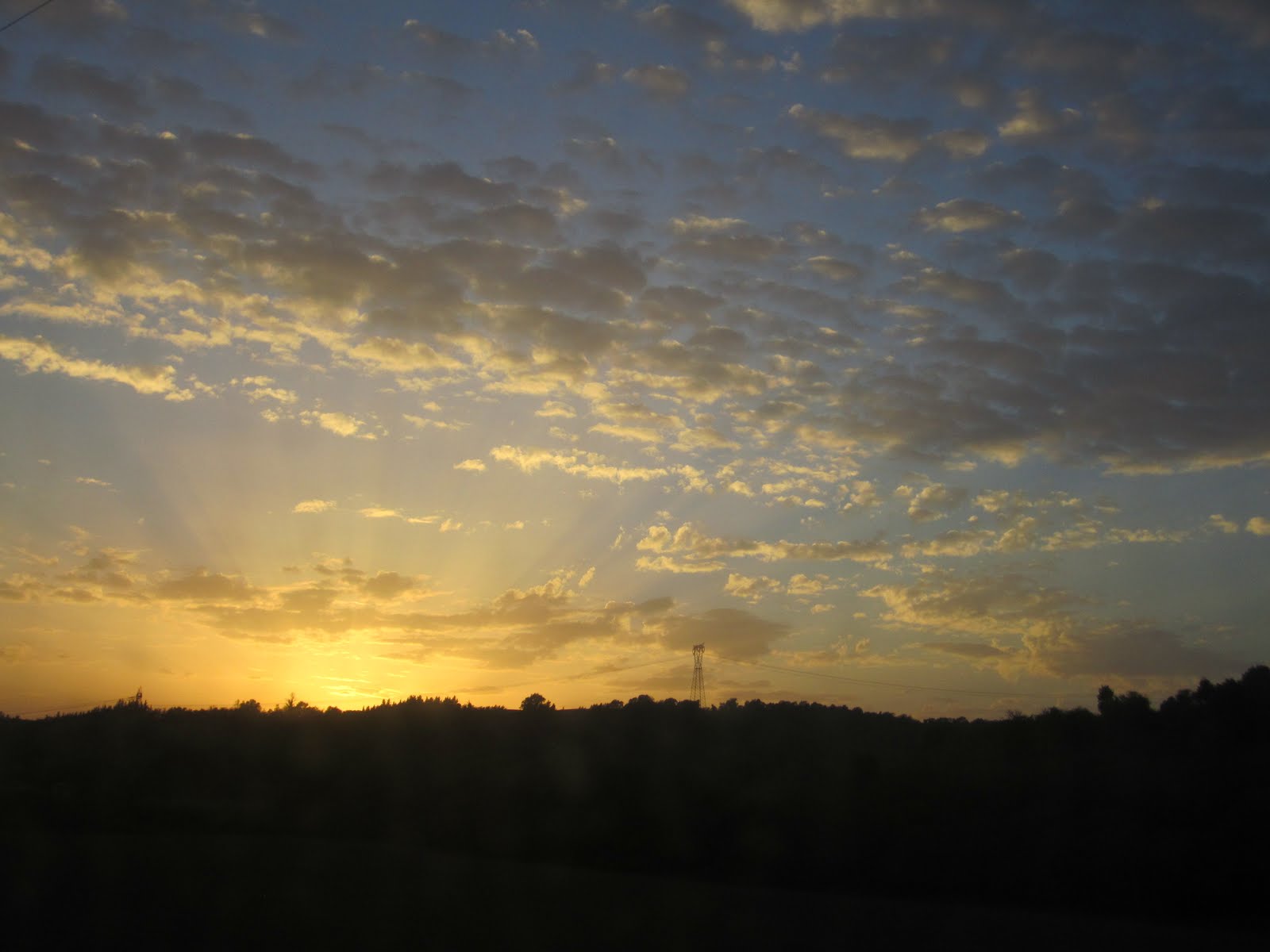
Nice view of the sunset from the train

Friday, November 9, 2012

Italy- Day 2, Rome

Our second day in Rome was all about the ancient centre of Rome- the forum.  On the way there we walked past the Trevi Fountain to try and see it before the busloads of coin throwing tourists blocked our view.  It is much larger than I expected- photos really do not do this incredible fountain justice.  It is sculpted to make it appear as though it is carved out of the same piece of stone that the building is made from, the transition between the building and the fountain is incredible.

Trevi Fountain
Fortunately we were organised and had pre-booked and printed tickets for the Forum (from the Italian tourism website you can get a ticket which covers the Forum, Palatine Hill and the Colosseum), which allowed us to skip straight past the 50 person deep line and straight into the forum.  Arriving in the first area is a bit overwhelming, there is so much to see but at the same time nothing to see.  The ruins of temples, parliament buildings, pillars and ornately decorated archways would not be much to see without some form of audio guide.  We did have one but unfortunately there were many detours along the path due to renovations so the guide did not match up with what we were looking at and made it difficult to really appreciate a lot of the ancient ruins.  It was still an incredible experience being right in the heart of world history.

Roman Forum
Arch of Septimus Severus, built in around 200AD to celebrate a Roman victory at war
Overlooking the forum is Palatine Hill which has ruins of the mansions belonging to Caesars among the gardens.  There was some great views over the forum and towards the Colosseum.

Palatine Hill
Our next stop was the San Pietro in Vincoli (St Paul in Chains) but unfortunately our visit was perfectly timed with its closure over lunch, so we ate some sandwiches while sitting on the stairs, and then it was off to the Colosseum.  Seeing the outline of the ancient ruins is exciting because it is such a recognisable image, and the inside is no letdown.  The complex structure of rooms beneath what would have been the arena was remarkable, even more so considering that it is still standing 2000 years later.


After stopping for a gelato and espresso, we walked to the Basilica di San Celemente, a 3 tiered building whose floors go down rather than up.  The levels get older as they go down, with the new ones having built on top of the previous ones, the oldest being from around 50AD.  It gave an interesting view of the architecture from different time periods, and the frescoed walls were also beautiful.

A few minutes further along the street was the Basilica di San Giovanni.  We went in from a side entrance and were blown away by how massive it was on the inside.  Exiting from the front, we had a great view of the main facade which matched the grandness of the inside.

Basilica di San Giovanni
Basilica di San Giovanni on the inside
At the reccommendation of a work friend, dinner was at a small restaurant on the main street down from the Vatican called Peccato Divino.  We weren't too sure at the start when it seemed that they did not want to seat us in the small upstairs dining room but they eventually took us to a table.  We are glad they did because the food was delicious and authentic.  We even got chatting with our waiter (despite his limited English) and found out that he used to work in a hotel just a few minutes walk away from our house in Amsterdam.  It was a great experience and well worth every euro.  After dinner was a relaxing walk along the edge of the Tiber and across the bridge back to our hotel.


Tiber at night

Thursday, November 8, 2012

Italy- Day 1, Rome

Our 3 days in Rome was packed full of world famous landmarks, incredible art and delicious food.  After leaving work and going straight to the airport on Friday afternoon, we were in the airport in Rome by 10pm but it was almost another 2 hours before we got to our hotel, partly due to getting lost in the main Termini train station which was under some heavy renovation. When we popped out of the Spagna metro station and were greeted by the Spanish Stairs and the fashionable crowds wandering along Via del Corso, we knew we were in one of the capital cities of the world.

Piazza Navona
The first full day was one incredible sight after another for 10 straight hours.  We started fairly early and had made the short walk from our hotel to Piazza Navona by 8am.  It was a beautiful blue day and we enjoyed our take-away cappacino and croissants sitting on a park bench near the fountain before the crowds of tourists arrived.
Fountain of the Four Rivers

We stopped off at a few nearby churches- Sant'Agostino and San Luigi dei Francesi which both contain famous paintings by Caravaggio, Sant'Ivo alla Sapienza whose intricate dome towers over it's beautiful column lined courtyard and Sant'Andrea della Valle which had an ornately decorated gold plated ceiling.
Caravaggio's Inspiration of St Matthew & Martyrdom of St. Matthew at  San Luigi dei Francesi
The courtyard at Sant'Ivo
Sant'Andrea della Valle
As we wandered out of Sant'Andrea della Valle we walked past Largo di Torre Argentina, a square that contains the ruins of several BC built Roman temples and the alleged spot of Julius Caesar's assassination. It was incredible that it was right there in the middle of the city, surrounded by normal modern life- a bus stop, a car-filled round about, a grocery store.
Largo di Torre Argentina
Our next stop was the Pantheon, but before we went there we visited Santa Maria sopra Minerva which was just outside.  This church had a statue of Christ from Michelangelo inside, and a statue of an elephant from Bernini outside.  Nothing however could compare to seeing the Pantheon for the first time- this massive concrete dome was breathtaking.  Its ancient looking exterior hid a very well maintained interior.  It really gave a sense of how deceptively large the building was when we read that the oculus (the hole in the top of the dome that provides natural sun light) is actually almost 8 metres in diameter- from the ground it looks much smaller than that.
Michelangelo's statue of Christ
Facade of the Pantheon
Inside the Pantheon
Sunlight from the oculus
After a quick gelato stop, we visited the Sant'Ignazio church which has, instead of a dome as was originally planned, a cleverly painted ceiling that makes it appear as if the dome is actually there.  The optical illusion disappears as you walk around and view the painting from a different angle.

Fake dome painted ceiling in Sant'Ignazio
We wandered through the streets for a while, past the column of Marcus Aurelius, before catching a bus to the Villa Borghese park for our pre-booked visit to the Galleria Borghese.  This gallery, home to , is one of the most famous and popular galleries- Despite our pre-booked tickets we had about a half hour wait outside the gallery and although we were glad to give our feet a rest while we ate some lunch, it was so hot that it was uncomfortable.  Once we were in the air conditioning that was all forgotten as we enjoyed the works by Bernini, Caravaggio and Raphael.  The audio guide was extremely useful as I don't know much about art and it really helped to give some context on the works.

Resting outside Galleria Borghese
Villa Borghese Park
The Villa Borghese park was quite big and had really cool trees, but it was dangerous as it was full of tourists on pedal powered carriages who were always threatening to run you down.  We came out at Piazza del Popolo at the top of Via del Corso, and found that the Champions League trophy was currently on display as part of its European tour.  The line was too long to get in, so instead we walked up to the hill which overlooks the piazza and were rewarded with some stunning sunset views over the city.

View of Rome from above Poazza del Popolo

After a stop off back at our hotel, it was off to dinner which was had at a pizza restaurant in the back streets of Campo di' Fiori.  We sat at a table that had a view of the pizza chef putting the freshly made pizzas into the wood fire oven.  


Wednesday, November 7, 2012

Food for Winter

November is pretty cold, grey and wet in Holland but the Dutch seem to use this as an excuse to invent delicious cold weather food.  This week I've come across some traditional Dutch winter foods that should make the weather a bit easier to bear.  Any of these would be perfect to eat in front of the fireplace on a cold rainy evening- but I guess I'll have to settle for eating in front of the heater.

Pepernoten
These spongy little cookies taste of ginger, cinnamon and a bit of aniseed.  They have a texture unlike anything I've tried before- they are not crunchy, but they are more solid than a cake or a muffin.

Pepernoten
Kruidnoten
Round and crunchy, Kruidnoten taste similar to gingernut biscuits but have some extra spices that make them taste like speculaas.  These are a specialty for Sinterklaas in early December.  They are delicious and really small so you always want just one more. 

Kruidnoten
Stamppot
My friend Yoram and his wife were lovely enough to invite us over for dinner and show us some genuine home made Dutch cuisine.  Deborah cooked us 'rauwe andijviestamppot met spek en rookworst'- raw endive stamppot with bacon, rookworst sausage and mustard.  This is basically mashed potato with some vegetables mixed in.  It sounds simple but tastes really good.  It is served with mustard and some fresh capsicum which cuts through the heaviness of the other ingredients- delicious.

Stamppot
Olibollen
An oliebol (literally 'oil ball') is like a ball shaped donut with raisins in it, normally served with a sprinkling of icing sugar.  This typical Dutch winter food is eaten especially on New Year's Eve but they are already being sold in November.  There is a temporary food cart set up on Museumplein that sells really good oliebollen.

Sunday, November 4, 2012

Bicycle Orphanage

The Amsterdam city council is proactive with removing old bikes from public areas- and they have to be because there are always thousands of old abandoned, stolen, broken, lost or illegally parked bikes locked on to pretty much any solid object you can find.  Every now and then they will go to an area and put bright orange warning stickers on all the bikes, and any bikes still there after the expiry date marked on the sticker will be taken away.  This time period could be hours for illegally parked bikes or a few days for public areas like central station.

These bikes are taken away to the Amsterdam Fietsdepot (Bicycle Depot).  If you find your bike missing you might be lucky enough to find it stored at the Fietsdepot.


A few weeks ago my bike was taken away- it was locked up in the bike rack outside our house, but they had a sign saying there would be council maintenance being done on a certain date and I didn't remove my bike in time.  So this weekend I made the long trek out to the Fietsdepot in Western Amsterdam.

The depot was a massive parking lot in an industrial estate that holds thousands and thousands of bicycles- the pictures don't really do it justice.  They are organised into sections and the staff were pretty efficient at taking some details of the lost bike (description, date lost, location from which it was taken) and tracking down which section of the depot it should be in.

Fortunately the people there were very nice and not at all judging towards any of the 50 or so people who were waiting in line with me to collect their bikes.  Unfortunately it was freezing cold and pouring with rain, so the hour cycle home was very uncomfortable.  But it is good to have my bike back, and I found out over the last few weeks how reliant I am on it now that I don't own a car.


Saturday, October 6, 2012

Den Haag


This weekend we visited The Hague. Known Den Haag in Dutch, it is officially called 's-Gravenhage which means "Count's Hedge" in Dutch.  It is not the capital of the Netherlands but is the home of the Dutch parliament and also the royal family.  End geography lesson.

Lots of green areas even in the city
The city felt really relaxed and seemed to have a much different demographic of people than Amsterdam.  There were much fewer tourists, and people seemed older. That being said, The Hague is a big city and we only spent a few hours in the centre, so it's not a lot to judge by.

Binnenhof overlooking the Hofvijver river

We first visited the M.C. Escher museum, an artist whose trippy and mind-bending drawings I first saw quite a few years ago but had no idea he wasa Dutch until last week.  The museum was full of his confusing but fascinating drawing which explore the infinity of space and eternity of time through equation based tesselations and unusual perspectives which remain confusing even after the third or fourth look.

Escher museum, in a former royal palace
M. C. Escher drawings

The Binnenhof is a cluster of important and historic buildings in the centre of town.  It was quite a beautiful area with a nice courtyard in the centre, next to the Hofvijver river.  It was a really interesting contrast with skyscrapers in the background behind these medieval aged buildings.

Dutch house inspired skyscrapers in the background
Binnenhof courtyard

We took a guided tour around a building that was once the prison 500-600 years ago.  Unfortunately the tour was in Dutch only but it was still really interesting.

The trams are red in The Hague!

The Hague is possibly best well known internationally for its role in international politics and war crime tribunals.  We visited the Peace Palace (Vredespaleis) which holds the International Court of Justice and various other international law bodies.  While we could not actually go in, there was a small but informative tourist centre, and the palace itself was a really beautiful building to see.

The Peace Palace (Vredespaleis)

After a bit more exploring and coffee and cake at one of the many nice little cafes, it was time the hour train ride back to Amsterdam.

Another view of the Dutch house skyscrapers